
Join us in
Celebration of Phase I of the Green Envelope Project,
Sunday October 25 at 11 am outside the Meeting House!
The Friends of the 1836 Meeting House has undergone a $1m restoration project.
Weather, age, and woodpeckers have taken a toll on the wood siding and spires. After two years of extensive assessment, contractors found no structural issues in the building; however, our project team determined that we needed to go beyond replacing damaged siding and repainting and create a water-tight exterior.
Weather permitting, work was scheduled for March-September 2026. Beginning with the front facade, successive sides of the building will be surrounded with scaffolding to provide access to damaged surfaces. The contractor will add insulation to exterior walls, replace siding, repair and paint the steeple, and replace the badly rotted ornate finials atop the steeple and the eight spires. This project is named Green Envelope because it represents a combination of restoration and improved energy efficiency.
We still need to raise some money, though $480,000 will come from a Community Preservation Act grant approved by North Andover town members in May 2024. Several generous donors have stepped forward. The rest needs to come from other sources, including members of our community.
Honoring Our Past - Creating Our Future - These words seem an apt description for the current preservation project underway at the 1836 Meeting House, known as the North Parish. This short video highlights the history of the project and the importance of the Meeting House to the community. Share our story with your neighbors and friends.
The Friends Organization
We were created by a group of local residents to inform, share, and support the ongoing preservation efforts of this historic building with the community-at-large. Our 501c3 non-profit will help maintain this classic 1836 Meeting House, which is a cornerstone of the historic Town Common.
The historic meeting house in the Old Center of North Andover is considered an iconic structure in North Andover and the Merrimack Valley, with its steeple and façade serving as a welcoming beacon day and at night. The existing structure, the fifth Meeting House, was built in 1836. It is part of the Old Center District of North Andover and is included in the National Historic Register and the local Historic District Register.
The 1836 Meeting House provides space to the North Parish Unitarian Universalist congregation, the Great Pond Buddhist Sangha, the Jewish congregation Ahavat Olam during the High Holy Days and The Peoples Food Pantry (501c3)
The Meeting House is also used by several community organizations and for community events. These include Red Cross Blood Drives, the monthly Crossroads Concert Series and other community-wide concerts, Bread and Roses meal preparation, a weekly McVagly GBLTQ Youth Support Group, multiple AA and AlAnon support groups, Community InRoads (501c3), nonprofit retreats, events, and workshops open to the community.
Learn about the Friends Grant Making.
Thanks for joining us for the
Fourth of July Declaration of Independence Recitation Event
on the Common.





Meeting House History

Early History
The original Meeting House was built on ground where the Pennacook Native Americans once lived. One of the Algonquin-speaking tribes, they farmed maize, corn, and squash along the riverbeds of the Merrimack and hunted the wooded areas. In 1645 residents of Andover (then known as Cochichawicke) formally established The First Church of Christ at Cochichawicke. The original congregation was the 37th church established by Puritan settlers of Massachusetts Bay colony.

The Meeting House
As the population grew over the years, the church's building, or "meetinghouse", was replaced four times until the present building was erected in 1836. By then Andover had been split into North and South parishes. As this church was located in the North, it became known as North Parish Church. In 1855 the north and south parishes legally became separate towns, Andover and North Andover.

The Sanctuary
Boston architect Richard Bond designed the 1836 Meeting House in the Gothic style highlighted by large expanses of glass, clustered columns, and sharply pointed spires. There is a balcony which holds the organ and provides access to the steeple. One floor above the balcony is the clock level and a floor above that houses the Revere bell. There are no internal support columns for the three story high ceiling in the sanctuary because the Bond design included robust wooden trusses located between the roof and ceiling.

The Paul Revere Bell
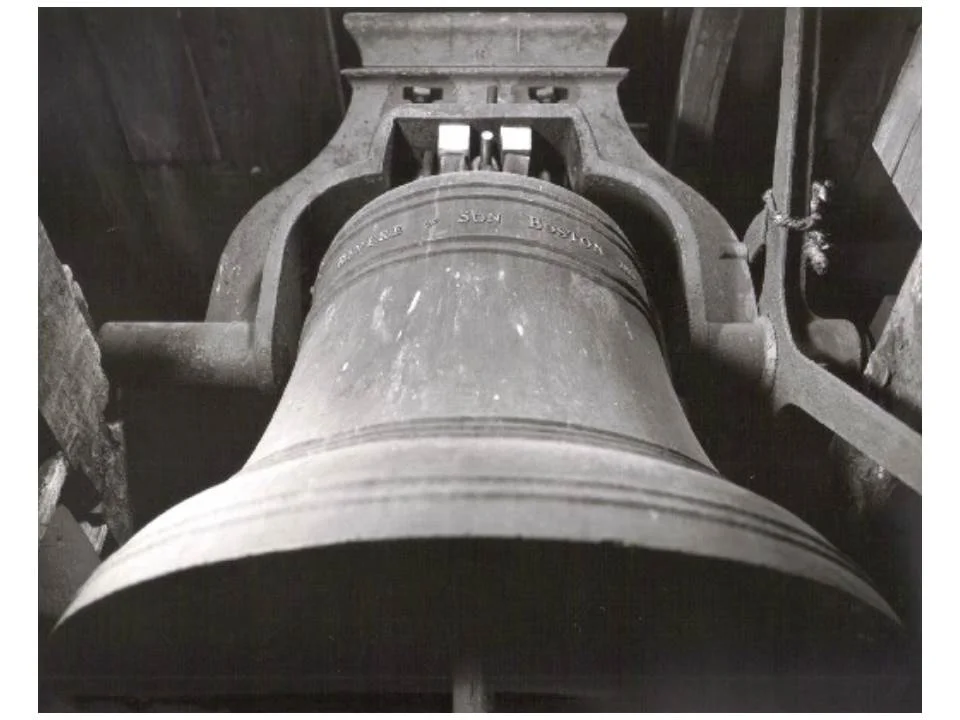
In 1807 the “freeholders and other inhabitants of the North Parish voted to accept Colonel Paul Revere’s proposal for a new bell to their meeting house” because the old one was broken. The new bell was listed as of “1200 weight” and was inscribed “Revere and Son- Boston, 1806” and cost 45 cents a pound ($540 total). Paul Revere and his second son, Joseph, were the bellmakers. The Meeting House bell is one of 23 remaining Bells cast by Revere during his tenure with the Foundry. It was hung in the Fourth Meeting House and then moved to the tower of the present Meeting House during its construction in 1836.

The Organ
The Meeting House has a Hook and Hastings organ (Opus 2559) installed in the sanctuary balcony. In its day, Hook was the premier organ building company in the United States. The Hook brothers were sons of a cabinet maker in Salem, Massachusetts where they apprenticed with the organ builder William Goodrich. They moved to Boston in 1832 and began producing larger organs. The Meeting House organ was donated by the Stevens and Osgood families in 1928 in memory of their parents Moses Tyler Stevens (1825-1907) and Charlotte Emeline Osgood Stevens (1831-1906).

The Clock
One floor below the Revere Bell in the steeple is the clock which faces the Common for all to see. The clock from the 4th Meeting House had been given by Benjamin Barker to the church in 1762. This clock was preserved and placed in the steeple of the 5th Meeting House in 1836. At the time, Mr. Simon Willard, a Boston Clockmaker, performed repairs for the sum of $300. The clockworks were updated around 1870 by the E. Howard Clock Company of Boston, MA. Other updates to the clock have been made since then which coordinate the ringing of the Revere bell.